
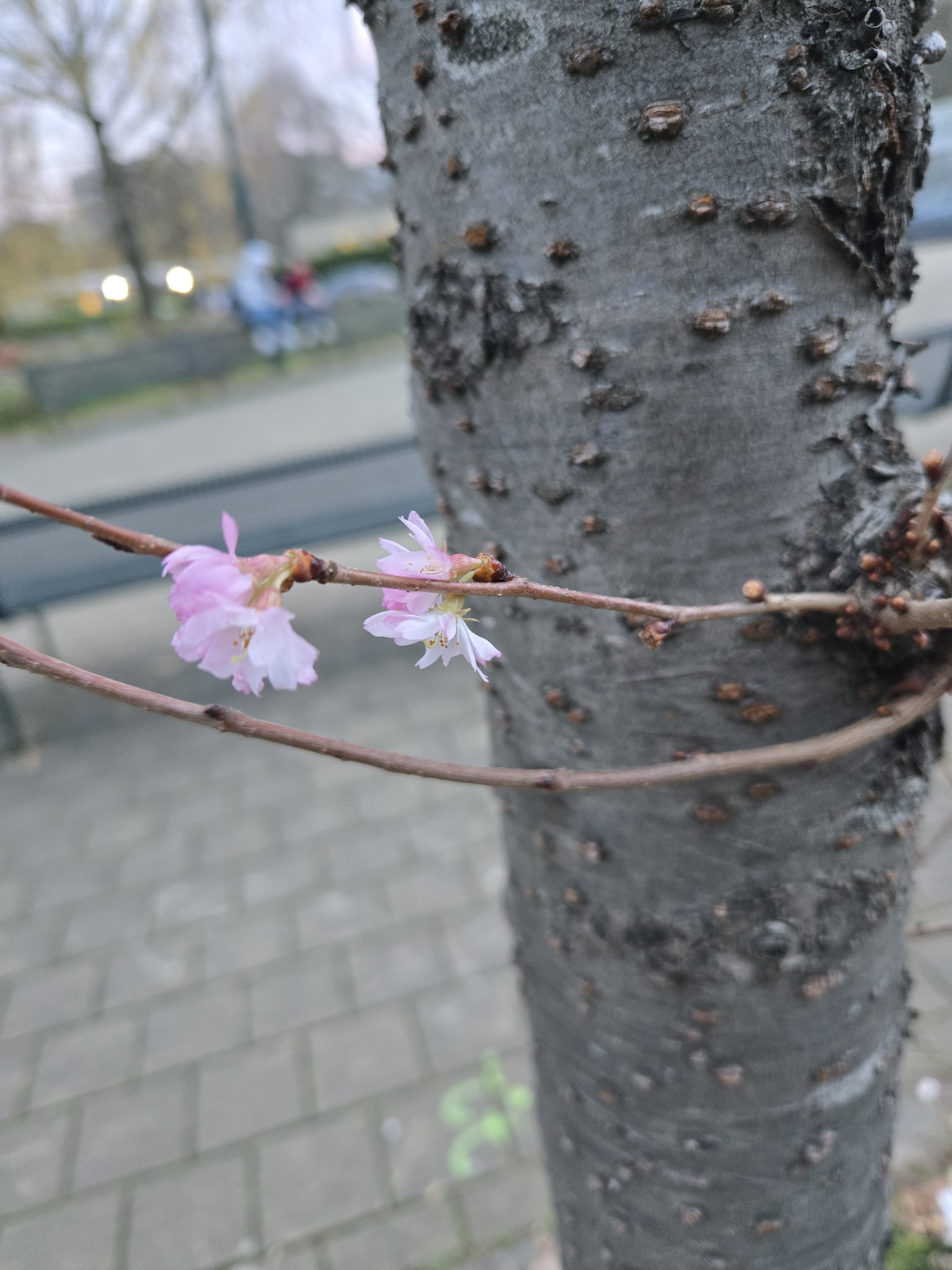
I took this picture this morning. Mid December in Belgium and it is definitely not normal. The following scenario rolled out in my head: what if all plants bloom in December, don’t get pollinated, then when bees wake up there’s no food, they are decimated. Wouldn’t that be a huge biological collapse?
I’m no expert in anything, just wanted to share this picture and thoughts
The good news is, you don’t have to worry about this scenario. For all practical purposes, it’s a fictional boogeyman.
There will never be a case where all plants bloom in December. Full stop. So, I wouldn’t worry too much about that scenario.
Generally speaking, flowering trees are not the only food sources available for bees in the cold seasons, or otherwise. Particularly if the discussion is geared towards the limited scope of honey bees. Perhaps on a hyper localized inner city block that’s the case, but outside of that, no. European honey bees are perfectly happy to feed on sugary food items in trash cans, for example. And in much of the world, there are plenty of suitable cold season flowering plants. We might not notice them much, especially inside a city, but they’re all over in many parts of the world.
Also, bees are not the only pollinators in much of the planet. There are a myriad wasps, beetles, flies, moths/butterflies, and so on that also actively pollinate flowers, even in cold seasons.
Honey bees in many parts of the world are active on days when the temperatures are actually quite cool. Doesn’t need to be much warmer than 50F/10C, if there are honey bees in the area, they may be out foraging, even if trees are flowering out of season. Other pollinators, like flower flies, can be active at even lower temperatures.
Honestly, I could go on, but I suspect it’s not strictly necessary. The summary is, the doomsday scenario you’re asking about might be a possibility in a hyper localized setting (i.e. inner city block), but it’s just not a thing that will ever happen on a wide enough scale to matter. That’s not to say there aren’t realistic scenarios where climate related biological collapse is a potential outcome, just that the scenario you described is not realistic.