Firemen know that, they are trained to use foam and dust for electrical fires even if no lithium batteries are present.
Also it’s hard (or close to impossible maybe?) to extinguish a burning car with water if the petrol or diesel tank catches fire. There isn’t much difference in that regard to EVs (maybe in terms of how long after the apparent flames a battery might rekindle the flames).
It took the firemen 45 minutes to put out my car after the full fuel tank ruptured.
An EV catching fire isn’t an ‘electrical fire’, it’s a metal fire. That’s why it takes so long to put out and you just kind of try to suffocate it and let it die out.
(I didn’t know/heard about it on safety meetings that the firefighters differentiate between them, but that makes sense. “Electrical fire” in the firefighter sense, which includes gasoline burning on some wires that carry current.)
Big battery safety is a very new thing tho, a bit like ice vehicles stopped being rolling fireballs after a few decades, I’m sure batteries will integrate fire safety features (ducts, chemicals, switches, or just different types of materials used to store charge).
Not true. They put out burning electric cars with water all the time. The issue is that it usually won’t stop the thermal runaway reaction - it just pauses it. The car might re-ignite on its own later. That’s why my local fire station has a container full of water that they submerge the car in to cool the battery pack down and actually stop the reaction.
According to various tests, water has been found to have the most effective cooling effect.
On the other hand, different reports have stated that extinguishing battery packs has in the worst cases taken several hours and required several cubic meters of extinguishing/cooling water.
Especially in Central Europe, in certain areas, so-called extinguishing platforms are commonly used for extinguishing and cooling electric vehicle battery fires. In the extinguishing platform method, the car is submerged in water. The advantage of this method is that it effectively prevents the fire from spreading, and the contaminated extinguishing water can also be collected. In the method, all battery cells - including undamaged ones - go into short circuit, and as a result, no combustion energy remains in the battery pack.
In practice, this means at least several days of submersion to ensure that all battery cells have short-circuited and that the battery’s charge has been completely discharged. As the fleet of electric vehicles becomes more widespread, it is worth considering whether submerging the vehicle is an efficient and appropriate method.


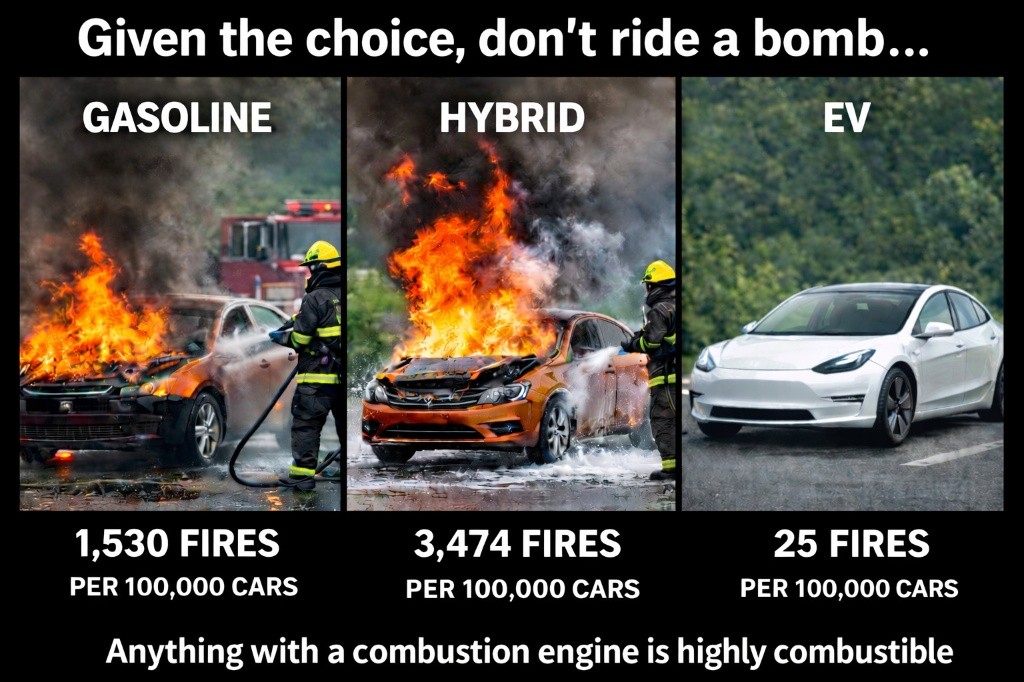
The problem is that water puts out fuel fires, but fuels battery fires.
Firemen know that, they are trained to use foam and dust for electrical fires even if no lithium batteries are present.
Also it’s hard (or close to impossible maybe?) to extinguish a burning car with water if the petrol or diesel tank catches fire. There isn’t much difference in that regard to EVs (maybe in terms of how long after the apparent flames a battery might rekindle the flames).
It took the firemen 45 minutes to put out my car after the full fuel tank ruptured.
An EV catching fire isn’t an ‘electrical fire’, it’s a metal fire. That’s why it takes so long to put out and you just kind of try to suffocate it and let it die out.
(I didn’t know/heard about it on safety meetings that the firefighters differentiate between them, but that makes sense. “Electrical fire” in the firefighter sense, which includes gasoline burning on some wires that carry current.)
Big battery safety is a very new thing tho, a bit like ice vehicles stopped being rolling fireballs after a few decades, I’m sure batteries will integrate fire safety features (ducts, chemicals, switches, or just different types of materials used to store charge).
Not true. They put out burning electric cars with water all the time. The issue is that it usually won’t stop the thermal runaway reaction - it just pauses it. The car might re-ignite on its own later. That’s why my local fire station has a container full of water that they submerge the car in to cool the battery pack down and actually stop the reaction.
Source (in Finnish)
You should use a fire extinguisher in any case
Please learn about fire extinguishers before using one.