In the US, we use a lot of prime farmland to grow corn that we turn into ethanol - 30,000,000 acres. Thirty million acres!
That ethanol is combined with gas (making the gas less efficient, by the way) and powers our cars in the US.
If you look at the number of miles the ethanol powers in the US, and calculate how many acres of solar we’d need to power electric cars to go that number of miles, we’d need to convert less than a quarter of a million of those acres to solar. So let’s round up from 214,000 acres to the 250,000 because… inefficiencies, or whatever.
So we could gain 29,750,000 acres of land to grow more food or whatever and stop growing corn to turn into ethanol just to burn it in our cars.
For that matter, if we wanted to use that ethanol land (JUST the land we’re using for ethanol) to power ALL cars in the US, switching everyone over to electric, it would only take about two million acres. Sure, 2,000,000 acres is a lot, but that would still be freeing up TWENTY EIGHT MILLION ACRES of land we’re using JUST to grow corn we turn into ethanol.
It does ignore anything like the chaos of forcing everyone to buy a new electric car, setting that infrastructure up - I’m not saying this would be easy, but it is stunning how much land we could stop abusing to grow corn to burn in our cars.
Mandating solar PV in all building codes nationwide, and incentivizing onshoring of all of the processes that go into manufacturing solar PV panels (including using trade protectionism practices such as tariffs AFTER WE ALREADY HAVE PROCESSING AND MANUFACTURING CAPABILITIES IN THE USA) will do wonders for helping average people transition away from fossil fuel Internal Combustion Engine (ICE) cars to EVs.
Many people who cry foul about EVs and renewables adding too much load to a grid that is too old and just can’t handle it forget the main counter to disarm their arguments: colocating generation with utilization.
Having solar PV (and other renewable) generation closest to where that power wants to be used is the best for the grid infrastructure (maybe not the grid investors) because it reduces residential/commercial load while maintaining the needs of the original giga users of the grid: Industry.
There are solutions to SO many of today’s problems. We just have politicians that are bought and sold by billionaires and their corporations who won’t do the public’s bidding. Voting progressive politicians in, and preferably ones who vocally claim they’re Democratic Socialist or similar, is the strongest way we push back against Big Oil, Big Coal, Big Tech, and all the other mega industries.
Theres a lot of misunderstanding going on here about both corn and solar power.
Corn is not something that requires ideal or fertile real estate. People imagine corn being grown in the stereotypical midwestern river-adjacent and particularly fertile type of places, like Iowa or Ohio or whatever. The reality is that modern corn production requires a shitload of artificial nitrogen fertilization, so the actual fertility of the land is virtually unimportant. Believe it or not, Texas is actually one of the most productive places for corn farming, and in particularly hot and arid areas where you wouldnt be farming much else. More like typical ranching land, not prime farming land.
Now with solar power, at the current levels of efficiency (and unlike corn), having a cloudy day is a major killer. UV intensity at high elevation can be virtually nothing when it gets a little cloudy. Whereas on a sunny say it would be extremely high. So you need ideally somewhere that is as high altitude as possible, but where it is also sunny almost all the time. There are not a lot of places that meet that description, and even the few places that do are largely very expensive to acquire land in because people want to build houses and hotels and golf courses and whatever else in (or adjacent to) the mountains. Take Pueblo, CO, for example. It’s one of the solar hubs of the US. But its difficult to expand from there because you can either go east, down in elevation, and increase the number of cloudy days. Or you can try to go west and everything becomes exponentially more expensive the closer you get to the Rockies.
More importantly though, corn and solar production necessitate two completely different environments. No one is growing corn in Pueblo, and you wont find many solar fields in places where corn is grown effectively. Because a lot of the time people grow corn where it rains often, therefore those places have many more cloudy days in a year. Realistically you cant just take corn fields and turn them into solar fields
If this is true then solar dominance would be very efficient for our society in your’s and op’s description because in this scenario, corn will still always be grown… however, it would be marginalized to its regions that can only grow corn as you described.
So we could gain 29,750,000 acres of land to grow more food or whatever and stop growing corn to turn into ethanol just to burn it in our cars.
What if there is another potato famine, (added: another potato destroying mold)? That corn creates food security because it can always be used as food while the ethanol is replaced with petrol.
Corn grown for ethanol is not edible by humans. Also, do you really think growing only 29,750,000 acres of corn instead of 30,000,000 acres is a meaningful difference? Because it’s not.
You suggest to grown none of those 30 million that are used for ethanol. That would be 30 million acres less out of 90 million that are used for corn. That’s a major chamge.
Corn grown for ethanol would not help in a food shortage, so for the idea of a food shortage, it is… not helpful.
We have plenty of land not being used right now that could be used to grow food.
But we don’t have a shortage of food. We have food being wasted and thrown away. We have plenty of excess food. This is like being worried about your driveway taking up valuable lawn space. It’s… not.
You can also scour the ground for pennies just in case you run out of money, too. It’ll technically bring in more money than you had before.
You could also keep a stash of aluminum cans to turn in for money as well in case you run out of money.
But the amounts of help these things would do is so incredibly minimal that there are much better uses of your time.
Yes. Technically. Growing less than one percent of the land we grow for ethanol corn would mean that extra less than one percent of corn we really don’t want to eat JUST IN CASE we needed that last tiny bit.
We could also easily open far more than that in farmland and grow other crops that are more edible first.
But yes, technically, we could grow food we neither want nor need.
We do not fucking need that land for food. There is no shortage of food. Nobody is fucking starving due to a lack of food. There is a lack of distribution, yes. But not a fucking lack of food.
Furthermore, converting 250k acres of that corn that we are NOT FUCKING EATING BECAUSE IT IS BEING USED FOR ETHANOL into solar that powers cars instead would ALLOW US TO GAIN ALMOST 30,000,000 ACRES OF LAND TO GROW FOOD.
Food that we do not fucking need in the first place.
You know the Irish wouldn’t have starved so bad if the Brits didn’t insist they export all food that wasn’t potatoes. Let’s not use bad policies as an example for why we can’t have good policies.
I was just posting nonsense in response to the commenter who didn’t read what they were responding to. But yeah, I did mean it in the sense that it is highly artificially selected grass. Most being all, the remainder being none
Bypassing the question of whether sugars and oils are edible (?), field corn is perfectly edible for humans. Field corn isn’t sweet corn, and doesn’t taste good as a vegetable. But we can eat it the same way most people throughout history have eaten corn - as a staple crop, as a grain like wheat, as corn flour, cornmeal, grits, parched corn, hominy, maza, etc, etc. We just choose not to.
And calling opposition to ethanol “oil and gas propaganda” is ridiculous. Like the comment you responded to point it out, ethanol is sold mixed with gasoline. The industries are synergistic, not competitive. They have a common interest in promoting internal combustion engine vehicles and opposing EVs.


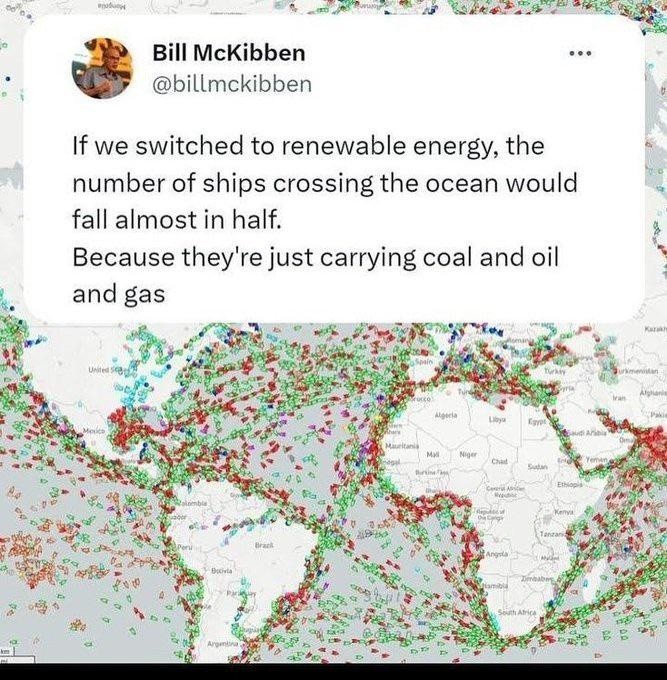
In the US, we use a lot of prime farmland to grow corn that we turn into ethanol - 30,000,000 acres. Thirty million acres!
That ethanol is combined with gas (making the gas less efficient, by the way) and powers our cars in the US.
If you look at the number of miles the ethanol powers in the US, and calculate how many acres of solar we’d need to power electric cars to go that number of miles, we’d need to convert less than a quarter of a million of those acres to solar. So let’s round up from 214,000 acres to the 250,000 because… inefficiencies, or whatever.
So we could gain 29,750,000 acres of land to grow more food or whatever and stop growing corn to turn into ethanol just to burn it in our cars.
For that matter, if we wanted to use that ethanol land (JUST the land we’re using for ethanol) to power ALL cars in the US, switching everyone over to electric, it would only take about two million acres. Sure, 2,000,000 acres is a lot, but that would still be freeing up TWENTY EIGHT MILLION ACRES of land we’re using JUST to grow corn we turn into ethanol.
It does ignore anything like the chaos of forcing everyone to buy a new electric car, setting that infrastructure up - I’m not saying this would be easy, but it is stunning how much land we could stop abusing to grow corn to burn in our cars.
Mandating solar PV in all building codes nationwide, and incentivizing onshoring of all of the processes that go into manufacturing solar PV panels (including using trade protectionism practices such as tariffs AFTER WE ALREADY HAVE PROCESSING AND MANUFACTURING CAPABILITIES IN THE USA) will do wonders for helping average people transition away from fossil fuel Internal Combustion Engine (ICE) cars to EVs.
Many people who cry foul about EVs and renewables adding too much load to a grid that is too old and just can’t handle it forget the main counter to disarm their arguments: colocating generation with utilization.
Having solar PV (and other renewable) generation closest to where that power wants to be used is the best for the grid infrastructure (maybe not the grid investors) because it reduces residential/commercial load while maintaining the needs of the original giga users of the grid: Industry.
There are solutions to SO many of today’s problems. We just have politicians that are bought and sold by billionaires and their corporations who won’t do the public’s bidding. Voting progressive politicians in, and preferably ones who vocally claim they’re Democratic Socialist or similar, is the strongest way we push back against Big Oil, Big Coal, Big Tech, and all the other mega industries.
If what you say is accurate, the other benefit would be that they wouldn’t even need prime, fertile real estate.
They’d just need any space with good sun capture.
Theres a lot of misunderstanding going on here about both corn and solar power.
Corn is not something that requires ideal or fertile real estate. People imagine corn being grown in the stereotypical midwestern river-adjacent and particularly fertile type of places, like Iowa or Ohio or whatever. The reality is that modern corn production requires a shitload of artificial nitrogen fertilization, so the actual fertility of the land is virtually unimportant. Believe it or not, Texas is actually one of the most productive places for corn farming, and in particularly hot and arid areas where you wouldnt be farming much else. More like typical ranching land, not prime farming land.
Now with solar power, at the current levels of efficiency (and unlike corn), having a cloudy day is a major killer. UV intensity at high elevation can be virtually nothing when it gets a little cloudy. Whereas on a sunny say it would be extremely high. So you need ideally somewhere that is as high altitude as possible, but where it is also sunny almost all the time. There are not a lot of places that meet that description, and even the few places that do are largely very expensive to acquire land in because people want to build houses and hotels and golf courses and whatever else in (or adjacent to) the mountains. Take Pueblo, CO, for example. It’s one of the solar hubs of the US. But its difficult to expand from there because you can either go east, down in elevation, and increase the number of cloudy days. Or you can try to go west and everything becomes exponentially more expensive the closer you get to the Rockies.
More importantly though, corn and solar production necessitate two completely different environments. No one is growing corn in Pueblo, and you wont find many solar fields in places where corn is grown effectively. Because a lot of the time people grow corn where it rains often, therefore those places have many more cloudy days in a year. Realistically you cant just take corn fields and turn them into solar fields
A lot of diesel is used in agriculture, maybe unnecessary agriculture.
The actual benefit of solar is that it is widespread so that cloudy days are less of an issue. Obviously storing the excess is a major objective too.
If this is true then solar dominance would be very efficient for our society in your’s and op’s description because in this scenario, corn will still always be grown… however, it would be marginalized to its regions that can only grow corn as you described.
I think that’s what you was coveying.
Are you just restating the numbers from the Technology Connections video? Or have you verified any of this research yourself?
I do watch Alec, but this came from my own - informal - work.
What if there is another potato famine, (added: another potato destroying mold)? That corn creates food security because it can always be used as food while the ethanol is replaced with petrol.
Corn grown for ethanol is not edible by humans. Also, do you really think growing only 29,750,000 acres of corn instead of 30,000,000 acres is a meaningful difference? Because it’s not.
You suggest to grown none of those 30 million that are used for ethanol. That would be 30 million acres less out of 90 million that are used for corn. That’s a major chamge.
Corn grown for ethanol would not help in a food shortage, so for the idea of a food shortage, it is… not helpful.
We have plenty of land not being used right now that could be used to grow food.
But we don’t have a shortage of food. We have food being wasted and thrown away. We have plenty of excess food. This is like being worried about your driveway taking up valuable lawn space. It’s… not.
Others have pointed out that it can be eaten as staple food.
Land doesn’t help if there is no food.
A reserve is for out of ordinary situations.
You can also scour the ground for pennies just in case you run out of money, too. It’ll technically bring in more money than you had before.
You could also keep a stash of aluminum cans to turn in for money as well in case you run out of money.
But the amounts of help these things would do is so incredibly minimal that there are much better uses of your time.
Yes. Technically. Growing less than one percent of the land we grow for ethanol corn would mean that extra less than one percent of corn we really don’t want to eat JUST IN CASE we needed that last tiny bit.
We could also easily open far more than that in farmland and grow other crops that are more edible first.
But yes, technically, we could grow food we neither want nor need.
Are you happy now?
I am sorry but I am not happy.
It was 30%.It could be used otherwise if we used elecrric cars but that wouldn’t create food security.
Well, not starving to death is a reasonable cause to do something.
Then there is other surplus food that has to be thrown away, or also be turned into ethanol.
For food it’s worth having a surplus. The bad part is that food is turned into ethanol while people starve to death.
We do not fucking need that land for food. There is no shortage of food. Nobody is fucking starving due to a lack of food. There is a lack of distribution, yes. But not a fucking lack of food.
Furthermore, converting 250k acres of that corn that we are NOT FUCKING EATING BECAUSE IT IS BEING USED FOR ETHANOL into solar that powers cars instead would ALLOW US TO GAIN ALMOST 30,000,000 ACRES OF LAND TO GROW FOOD.
Food that we do not fucking need in the first place.
Jesus fucking christ.
Have a nice day. I’m done. Goodbye.
You know the Irish wouldn’t have starved so bad if the Brits didn’t insist they export all food that wasn’t potatoes. Let’s not use bad policies as an example for why we can’t have good policies.
I meant to say that the problem could be another potato destroing mold. The famine could be avoided by switching to ethanol corn.
Not growing that corn would lead to the same result as exporting it.
not actually true. This is oil and gas propaganda.
Most of the corn grown in the US is not edible. Barely 1.5%. Most of it is grown for sugars, oils and other industrial processes.
did you read the whole comment? alexander already stated that
not actually true. This is oil and sugar propaganda.
Most of the corn grown in the US is grass. 100% of it, in fact. Soybeans make up a large percentage of animal feed.
…grass? you mean feed?
or do you mean maise technically being a grass, but having diverged greatly from it’s original form via agricultural selection?
if that’s the case, when you say most, what’s the remainder then?
I was just posting nonsense in response to the commenter who didn’t read what they were responding to. But yeah, I did mean it in the sense that it is highly artificially selected grass. Most being all, the remainder being none
ty for the explanation
Bypassing the question of whether sugars and oils are edible (?), field corn is perfectly edible for humans. Field corn isn’t sweet corn, and doesn’t taste good as a vegetable. But we can eat it the same way most people throughout history have eaten corn - as a staple crop, as a grain like wheat, as corn flour, cornmeal, grits, parched corn, hominy, maza, etc, etc. We just choose not to.
And calling opposition to ethanol “oil and gas propaganda” is ridiculous. Like the comment you responded to point it out, ethanol is sold mixed with gasoline. The industries are synergistic, not competitive. They have a common interest in promoting internal combustion engine vehicles and opposing EVs.