
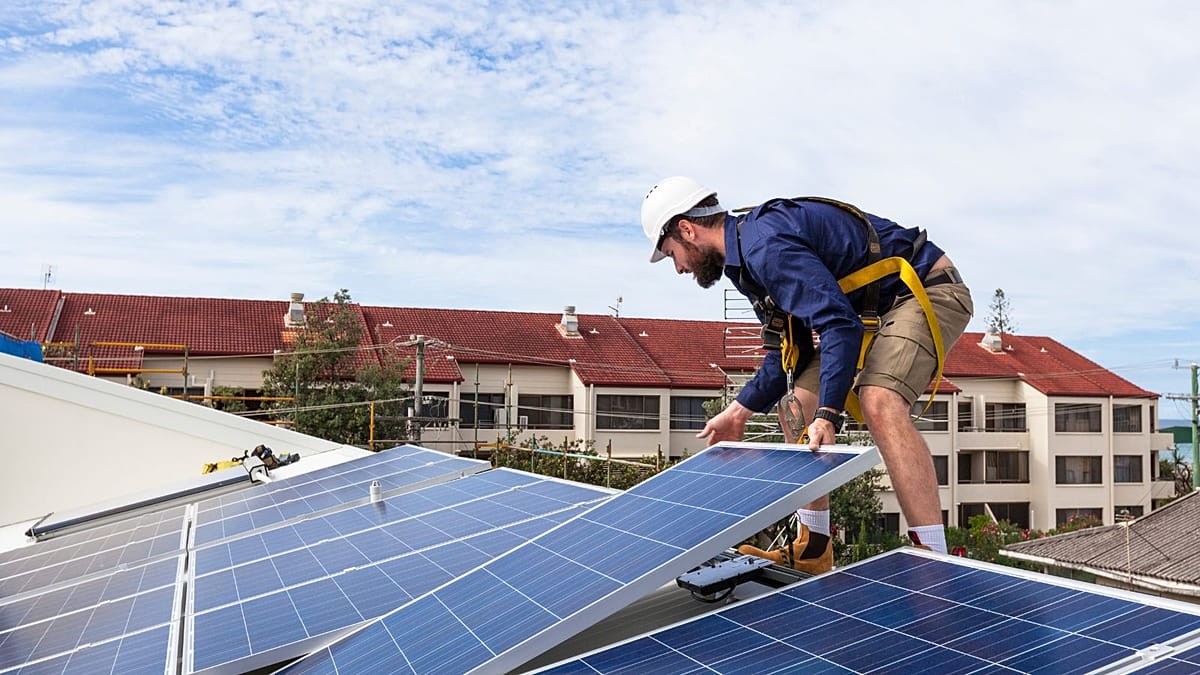
Installing solar panels on your home or business is common in many European countries. But they really come into their own during energy crises.
“If you’ve got a solar roof on your home and you’ve got a battery then, depending on how much energy you can generate, you are substantially insulated from importing electricity,” explains Matthew Clayton, CEO of UK-based Thrive Renewables.
Dynamic tariffs are becoming more common in Europe. This is where the price of electricity varies throughout the day and night, with costs going up during peak periods, like dinner time, when households are using more.
This means that if you store up solar power during daylight hours, when the sun is at its strongest, then you can use that energy, rather than drawing it from the electricity grid, during the most expensive periods. “Your relationship with the grid is totally changed,” says Clayton.
Grid going down?
I think the last time I experienced that was 15 years ago. Even then it was only for a couple of hours.
Like it’s such a non event as to not even bother trying to fix it.
It happened in Spain last year and it lasted for a day more or less. You never know.
At what point is a 1 in X event need to be likely to occur for it to be worth spending thousands on, if not 10,000’s?
If you’re framing it as “…worth spending…” then you can do the sums, if you like.
e.g. if you have a 1 in 1000 event that is 24h without electricity (once every 2 or 3 years?) You’d normally spend 30 a day on electricity, plus a cost for the convenience of not having it happen, lifetime of what 10-20 years, so multiply that up.
And if you can quantify the other benefits (using the variable daily rates, etc) then you get a better estimate.
So your thought is valid (in a quantitative / utilitarian kinda way), but not new. It looks to me like we are at or approaching the point where for people who put high value on convenience, it is worth it. For those who don’t, it isn’t.
I have literally never even heard of my grid going down for 24hrs and I’m not talking constraint to my lifetime. To think it happens every 2 years is outstanding.
You also do not get any additional benefits. The cost is being able to run off grid doesn’t get to any additional benefits like being sell back to the grid. Obviously you need to pay for batteries and stuff beforehand and the logical reason for buying batteries stands. But to upgrade your system to an event that has literally never happened before seems silly.
Spain just royally fucked up on a grid level and not something that is likely to occur again. They need to spend more on their grid which they are.
Being prepared for emergencies always seems silly and unnecessary - until that emergency actually hits.
In berlin in december, people sabotaged an electrical substation which led to an entire district losing power. People had no heating, couldn’t go shopping and millions of euros worth of food went bad. In most cities it’s not a problem as every german city (usually) has multiple mobile powerstations, basically a mobile power plant. Well, turns out, berlin only had 3 of them, unlike munich, for example, which has 120.
My girlfriend also recently told me that in some american state (Can’t remember which one exactly), hundreds of thousands of cows froze to death because it got unusually cold. Since the stables are all open (because it’s never that cold), most farmers were unable to intervene in time so most of the cattle died out there.
Or may I remind you of the time texas was hit by a massive snow storm, most of the state lost power and some people actually died because of the temperature? And all because it’s just a “rare occurence” and barely anyone was prepared.
I’m not saying you have to prepare for any eventuality like internet crashes or other stuff that doesn’t cost potentially kill you if it’s gone, but having a backup plan for power outages during winter or maybe a few barrels of clean water in case the water supply gets contaminated is probably not a terrible idea.
Being prepared for emergencies is a good thing. But not everything we do has to actively prepare for an emergency.
This article is about people installing equipment that alleviates their energy costs and reduces the amount of energy they draw from the grid, especially during high demand times. That is worth doing, entirely separately from being prepared for emergencies.
So the fact that this equipment does not prepare for emergencies is relevant to know, but doesn’t change whether it’s a good idea to install the equipment.
The article is about that, yes, but the comment I replied too talked about the grid going down.
What people never seem to realize is that the most popular solar panel + inverter + battery configurations do not work when the grid goes down. Newer systems often have 1-2 outlets that are dedicated as “works with grid failure”.
This is by design so maintenance workers don’t get electrocuted working on lines that are thought to be unpowered.
You need special inverters with built in grid detection and independent frequency generation AND a switch between your meter and your house so that it will dynamically start/stop grid tying (or at least have a manual DPDT/DP4T high amp switch.
Um… wouldnt it already have all that stuff? How would it cleanly switch to grid power once the batteries are drained.
Is that true? My system and everyone I know who has one all work fine with the grid goes down. I lose 220v outlets but I only have a couple things on that.
Texas should have spent money on it’s grid for sure. Maybe farmers shoukd do for wood.
But spending crap loss of money to create someone that might come in handy once in 10 years is a huge waste of money.
Just buy a battery if you really that concerned.
Not being at risk of death once every 10 years seems to be a great deal to me ngl.
Do you drive or ever let anyone else drive you?
So because we can die in an accident we shouldn’t have measures in place to prevent injury or death in other situations? What kind of argument is that? Also, guess why we have many security measures in a car, like seat belts, ABS, etc. You’re right - it’s to MINIMIZE the risk of injury or death. We know that it’s dangerous and do our best to minimize it.
Look, if you don’t want to prepare for the worst, it’s fine, nobody forces you to. In an emergency, you might be able to look for a person that did prepare and might save your ass. And after that event, maybe you will prepare some necessities yourself.
You don’t minimise the risk of car death because you are way better putting in measures to reduce your risk of dying in a car crash than dying in some weird grid failure that happens once in a generation.
It’s about understanding risk. You can’t just say avoiding any risk for anything all the time is good.
You just chose a hill to die on. That a 1 in a million chance whatever the cost is worth it.
But moving closer to work, a WFH job, cycling, only getting things delivered to you house, taking the bus, walking. No that’s too much you have a seatbelt.
Yea well I have a blanket and a grid that has never gone for an extended period in my lifetime. I’ll be fine. I have been in more car crashes as an adult than I have been in blackouts. Car avoid is a much better exercise in spending money than grid back up.
Hell for grid back up a standalone batter or generator to run the fridge is a better spending of money. Or an electric car.
But again it’s your hill to die on so feel free.