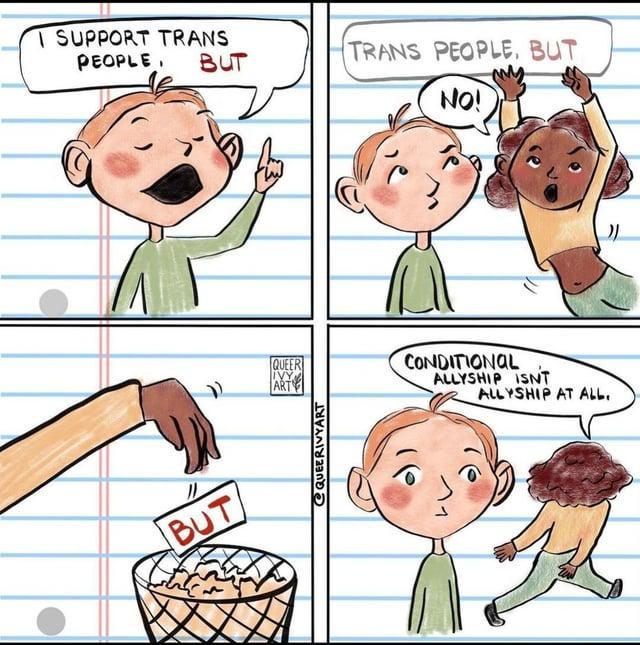
The presence of the but in that statement indicates it isn’t true. And that would be the case for any “I support” statement.
To me it seems like the obvious point of prepending a support statement to a separate objection would be to clarify that what you mean by that objection is not broad hostility, if it seems people might confuse it for that otherwise. There’s better ways to word it (maybe split into multiple sentences), but I don’t think someone saying “but” necessarily is trying to convey that the thing they are objecting to competes with or outweighs their support.
With most things, I would tend to agree. It’s just that with marginalized groups, that “but” is only rarely going to be something that’s not just a dismissal of some part of the fundamental issues that make the group marginalized in the first place.
Not sure who has experienced what, but here in the south I have lost track of how many times I’ve heard things like “black people are great, but…” or “I don’t have anything against gays, but…”
There’s a way of thinking behind buts when applied to this kind of matter that’s different from “I like shrimp, but…”
People making that kind of statement disingenuously is definitely a negative trope for a reason, and because people are likely to interpret it in light of that trope it is bad etiquette. The reason it’s misused that way though is because it is one of the simplest ways to frame a statement of polite disagreement. If people not wanting to attack marginalized groups avoid saying it, that’s probably more because most of them have picked up on the etiquette rule rather than because the inherent meaning of such a statement is an attack.

To me it seems like the obvious point of prepending a support statement to a separate objection would be to clarify that what you mean by that objection is not broad hostility, if it seems people might confuse it for that otherwise. There’s better ways to word it (maybe split into multiple sentences), but I don’t think someone saying “but” necessarily is trying to convey that the thing they are objecting to competes with or outweighs their support.
With most things, I would tend to agree. It’s just that with marginalized groups, that “but” is only rarely going to be something that’s not just a dismissal of some part of the fundamental issues that make the group marginalized in the first place.
Not sure who has experienced what, but here in the south I have lost track of how many times I’ve heard things like “black people are great, but…” or “I don’t have anything against gays, but…”
There’s a way of thinking behind buts when applied to this kind of matter that’s different from “I like shrimp, but…”
People making that kind of statement disingenuously is definitely a negative trope for a reason, and because people are likely to interpret it in light of that trope it is bad etiquette. The reason it’s misused that way though is because it is one of the simplest ways to frame a statement of polite disagreement. If people not wanting to attack marginalized groups avoid saying it, that’s probably more because most of them have picked up on the etiquette rule rather than because the inherent meaning of such a statement is an attack.