

so the goal is to transport renewable energy from the point of production (e.g. coastline for offshore wind) to the point of consumption (e.g. big factory 300 miles from the coast).
what is the cost of doing this? when comparing different technologies. i.e. you can just build a cable and transport the electricity through that, or you convert the energy into hydrogen at the point of production, then pipe that hydrogen gas through a pipeline to the point of consumption. many big consumers can naturally consume hydrogen instead of electric power anyways, for example large steel mills. they require power for heating and reduction, but in both cases, both power sources can be used (for reduction, electrolysis vs. chemical reduction).
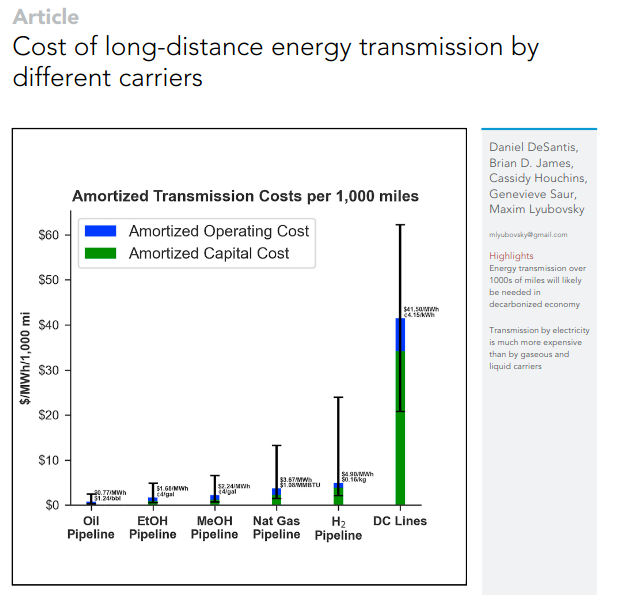
it’s well-known that the LCOE (levelized cost of electricity) for solar and wind is around 6 ct/kWh (citation needed, i’m citing from memory). so what is the cost of transporting that electric power over 300 miles? according to the diagram, it’s 4 ct/kWh over 1000 miles, so probably 1.33 ct/kWh over 300 miles using wires. so it makes a small part of the cost.
meanwhile if you use hydrogen, you have around a 70% conversion+storage efficiency (electric power -> hydrogen, plus storing it in an underground cavern) (source: this paper and german wikipedia about hydrogen storage). so to produce 1 kWh hydrogen, you need 1.4 kWh electricity at the cost of 1.4 * 6 ct/kWh = 8.4 ct/kWh. transmitting it over the pipeline, meanwhile, costs almost nothing, as seen in the diagram.
so in summary, producing+storing+transmitting hydrogen is slightly more expensive than just producing+transmitting electric power, but that already includes the storage cost. for electric power, you need additional batteries which i’m too lazy to write about now. just to give you an idea.
Power transmission is hard.
The wire, the complex components, keeping it all in phase and steady and not exploding, the maintenance…
I cannot emphasize this enough. People tend to trivialize this when talking about remote production, but moving electricity long-distance is basically the hardest part. And pipes really are dead-simple in comparison.
It’s also why local production is so appealing.
I was aware conceptually that it’s really complicated, but where are the costs going? Is this due to labor costs? Material costs? something else? What makes it so expensive to build and to operate, especially compared to pipelines.
I am not a power engineer, but I do know the capital costs for the wire and components all along the way is massive. They’re complicated, and they require a lot of expensive (and probably carbon intensive) materials.
Basic physics dictates it. Its more complicated than small scale DC/AC current with negligible transmission time you’re likely thinking of.
Maintenance is a pain, too. HV wires (especially the crazy DC ones) are extremely, extremely dangerous and basically can’t be near anything.
I’m not sure about installation labor costs vs a pipeline though.
That’s true of pipelines, too. It’s just that the sheer quantity of energy contained in those chemical bonds of chemical fuel is massive, so amortizing the up-front capital costs across how much energy can actually move through that pipe or cable in its lifetime tends to favor a pipe full of chemical energy, on a per kWh (or per joule) basis.
They are also pretty lossy too right? Some percentage of the energy you are moving is lost to heat
Yes, though that’s true of other methods.
Another big factor is that its very inconvenient to buffer vs tanks on either end, for transmission breaks that take time to repair, uneven energy supply/demand and stuff like that. Or even just capacitance.
A big old tank of oil on either end is cheap.
I’m not trying to shill for hydrogen or anything (I don’t like hydrogen), but this is definitely an issue.