

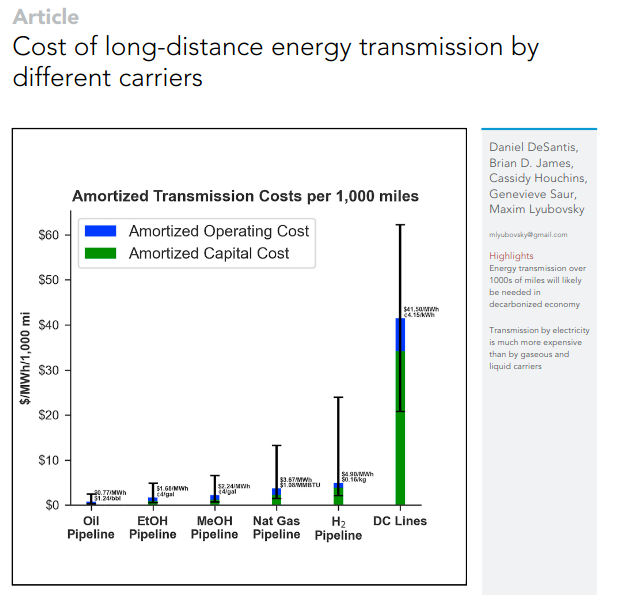
so the goal is to transport renewable energy from the point of production (e.g. coastline for offshore wind) to the point of consumption (e.g. big factory 300 miles from the coast).
what is the cost of doing this? when comparing different technologies. i.e. you can just build a cable and transport the electricity through that, or you convert the energy into hydrogen at the point of production, then pipe that hydrogen gas through a pipeline to the point of consumption. many big consumers can naturally consume hydrogen instead of electric power anyways, for example large steel mills. they require power for heating and reduction, but in both cases, both power sources can be used (for reduction, electrolysis vs. chemical reduction).
it’s well-known that the LCOE (levelized cost of electricity) for solar and wind is around 6 ct/kWh (citation needed, i’m citing from memory). so what is the cost of transporting that electric power over 300 miles? according to the diagram, it’s 4 ct/kWh over 1000 miles, so probably 1.33 ct/kWh over 300 miles using wires. so it makes a small part of the cost.
meanwhile if you use hydrogen, you have around a 70% conversion+storage efficiency (electric power -> hydrogen, plus storing it in an underground cavern) (source: this paper and german wikipedia about hydrogen storage). so to produce 1 kWh hydrogen, you need 1.4 kWh electricity at the cost of 1.4 * 6 ct/kWh = 8.4 ct/kWh. transmitting it over the pipeline, meanwhile, costs almost nothing, as seen in the diagram.
so in summary, producing+storing+transmitting hydrogen is slightly more expensive than just producing+transmitting electric power, but that already includes the storage cost. for electric power, you need additional batteries which i’m too lazy to write about now. just to give you an idea.
Why is DC power so much more expensive than pipelines?
DC power is pretty much ready to use.
pipelines are raw material with an energy capacity of which a much lower percentage can be used due to conversion inefficiencies
Pipelines are absurdly efficient because moving liquid or gas through a pipe is absurdly efficient per kilogram per kilometer, and the energy density of fossil fuels is absurdly high.
A Tesla supercharger v4 can deliver 500 kW of power. BYD has launched chargers that can deliver 1000 kW (aka 1 MW) to a single car. Naturally, each kW of power is capable of delivering 1 kWh per hour.
What is the equivalent flow rate in gasoline? 1 gallon of gasoline contains the equivalent of 33.4 kWh (1 L contains 9 kWh). So 1000 kW would be the equivalent of 30 gallons per hour (110 L/hr), or 0.5 gallons (1.85 L) per minute. That’s 5% of the rate of a typical gasoline pump in the United States.
Plus exposed high voltage wires need to be maintained in weather and around vegetation, so they have high operating costs. Then there’s higher capital costs of making sure that there are transformers and safety equipment that step the voltage up and down and sync with the rest of the grid.
In the end, it really is that power lines aren’t capable of carrying nearly as much energy as the chemical fuels that flow through a pipe, so on a per joule/kwh basis, there’s less economy of scale from power lines.
One problem with that comparison is that, sure gasoline has a really high calorific value. Shame you put it in a machine with 20% efficiency.
I would think that the graph would be rather different had it been “last kilometer”? I’d expect to see electricity at the bottom there.
Yes, the numbers change for shorter distances. There’s some loss in loading up a fuel tank and driving it to the station. But again, the high energy storage capacity of chemical energy still makes a huge difference.
If a loaded semi gets 8 miles per gallon of diesel, then moving a tanker full of 10,000 gallons of gasoline 200 mile (320 km) s will burn 25 gallons of diesel in order to transport 10,000 gallons of gasoline. Even with less efficient trucks (let’s say 6 mpg for 33.3 gallons of diesel burned), it’s still pretty efficient in terms of “losses,” of about one third of one percent of the original volume of fuel consumed. Of course, diesel is more energy dense than gasoline, especially gasoline mixed with ethanol, so the efficiency might drop to 99.5% instead of 99.7%, but we’re still talking about a pretty fundamentally efficient operation.
The real efficiency gains of electricity over fossil fuel (or any chemical fuel) comes from the more efficient motors. An electric car that goes 3 miles (5 km) per kwh is the equivalent of going 100 miles per gallon (42 km/L) of gasoline. A heat pump that has 300% efficiency only needs to transmit 1/3 as much electrical energy as would have been necessary for bringing fuel to a combustion-based heater.
So if you start breaking it down by actual use case, you might be able to make some gains back to mitigate the higher cost of transporting electricity across large distances. But it still remains that all the other methods are very efficient, too.
All those fuel stations you have to build and operate… And the energy losses to move your car to those fuel stations.
Indeed, this paper seems to calculate around the goal of making powerlines look costly by cutting it to a dedicated process step. If you look at it end-to-end process from production to consumption transportation, it very likely looks different
Wow, that’s a lot of food for thought.
Food energy tends to be measured in kcals though
Power transmission is hard.
The wire, the complex components, keeping it all in phase and steady and not exploding, the maintenance…
I cannot emphasize this enough. People tend to trivialize this when talking about remote production, but moving electricity long-distance is basically the hardest part. And pipes really are dead-simple in comparison.
It’s also why local production is so appealing.
I was aware conceptually that it’s really complicated, but where are the costs going? Is this due to labor costs? Material costs? something else? What makes it so expensive to build and to operate, especially compared to pipelines.
I am not a power engineer, but I do know the capital costs for the wire and components all along the way is massive. They’re complicated, and they require a lot of expensive (and probably carbon intensive) materials.
Basic physics dictates it. Its more complicated than small scale DC/AC current with negligible transmission time you’re likely thinking of.
Maintenance is a pain, too. HV wires (especially the crazy DC ones) are extremely, extremely dangerous and basically can’t be near anything.
I’m not sure about installation labor costs vs a pipeline though.
That’s true of pipelines, too. It’s just that the sheer quantity of energy contained in those chemical bonds of chemical fuel is massive, so amortizing the up-front capital costs across how much energy can actually move through that pipe or cable in its lifetime tends to favor a pipe full of chemical energy, on a per kWh (or per joule) basis.
They are also pretty lossy too right? Some percentage of the energy you are moving is lost to heat
Yes, though that’s true of other methods.
Another big factor is that its very inconvenient to buffer vs tanks on either end, for transmission breaks that take time to repair, uneven energy supply/demand and stuff like that. Or even just capacitance.
A big old tank of oil on either end is cheap.
I’m not trying to shill for hydrogen or anything (I don’t like hydrogen), but this is definitely an issue.
Because DC is produced electricity, and it takes burning around 10x the joules or more of hydrocarbons to match that power